CNC-Machined
Machined channel geometry with a bonded, brazed, or welded cover — flexible for prototype and complex geometries.
Cold plates are metal heat-transfer components that use a flowing liquid coolant to remove heat directly from high-power electronics — far more effectively than air cooling alone. This guide explains how they work, the main types, and how to choose the right one.
A cold plate is a metal plate, usually copper or aluminum, with internal channels that carry liquid coolant beneath a heat-generating component. Heat conducts into the plate, transfers to the coolant, and is carried away to a remote heat exchanger, chiller, or CDU.
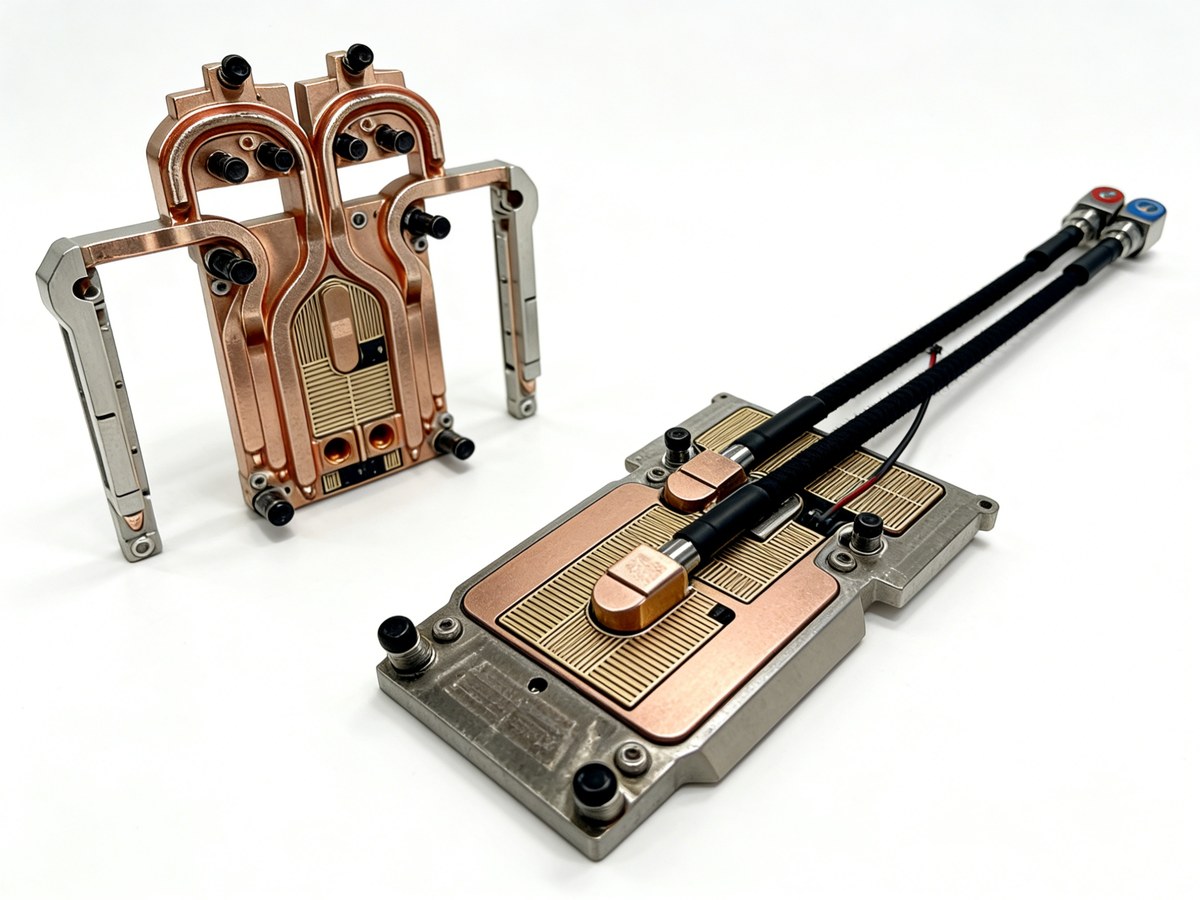
A cold plate mounts directly against a heat-generating component — a GPU, CPU, IGBT module, or battery cell, for example. Internal channels or a manifold route liquid coolant (typically water, a water/glycol mix, or a dielectric fluid) through the plate. Heat conducts from the device into the plate wall, transfers into the coolant by convection, and is carried away to a remote radiator, heat exchanger, chiller, or coolant distribution unit (CDU) for rejection.
Because liquid has a much higher heat-carrying capacity than air, cold plates can remove significantly more heat from a smaller footprint than an air-cooled heat sink, which is why they are standard on high-density AI/GPU servers, EV power electronics, and other high heat-flux applications.
| Heat sink | Relies on airflow across fins to reject heat. Simple and low cost, but limited by air's low heat-carrying capacity at high power density. |
|---|---|
| Cold plate | Uses flowing liquid coolant inside the plate for active, high heat-flux removal — the standard choice for concentrated or multi-source high-power loads. |
| Vapor chamber | A sealed, passive two-phase device that spreads heat across a compact planar area from a concentrated hot spot, without an active coolant loop. |
Machined channel geometry with a bonded, brazed, or welded cover — flexible for prototype and complex geometries.
Sealed multi-layer construction for compact internal channels and high heat-flux packaging.
Solid-state joining suited to large aluminum structures with sealed channels.
Tube routed into a machined or extruded base — a cost-sensitive option for defined tube paths.
Fast, accurate quotation depends on boundary conditions, not only a product name. Send enough data for a focused engineering review:
Send drawings, heat load, coolant, flow rate, pressure drop limit, envelope, target quantity, and timeline. An engineer reviews every RFQ and replies by email with next steps.
Cold plates are metal heat-transfer components, usually machined or brazed from copper or aluminum, with internal channels that carry a liquid coolant directly beneath a heat-generating component to remove heat more effectively than air cooling.
A heat sink typically relies on airflow across fins to reject heat. A cold plate uses a flowing liquid coolant inside the plate itself, which can remove far more heat from a smaller footprint than air cooling alone.
Common types include CNC-machined channel plates with a bonded cover, vacuum-brazed multi-layer plates, friction stir welded (FSW) aluminum structures, and tube-embedded plates, each suited to different heat flux, pressure, and cost requirements.
Selection depends on heat load and heat flux, coolant type, envelope and weight limits, pressure-drop budget, and production volume. Send drawings and these boundary conditions for an engineering review before selecting a route.
For a deeper technical treatment of cold plate design trade-offs, see the independent engineering brief Design Considerations for High Performance Processor Liquid Cooled Cold Plates from Electronics Cooling.
Review CFD, FSW, TLP, vacuum brazing, and leak testing capabilities.