BEV Battery Modules
Prismatic, pouch, and cylindrical cell cold plates for battery-electric vehicle pack thermal management.
ToneCooling Texas helps US battery teams review EV battery cold plates for temperature uniformity, coolant routing, aluminum structure selection, sealing, and production feasibility.
ToneCooling Texas helps US battery teams review EV battery cold plates for temperature uniformity, coolant routing, aluminum structure selection, sealing, and production feasibility.
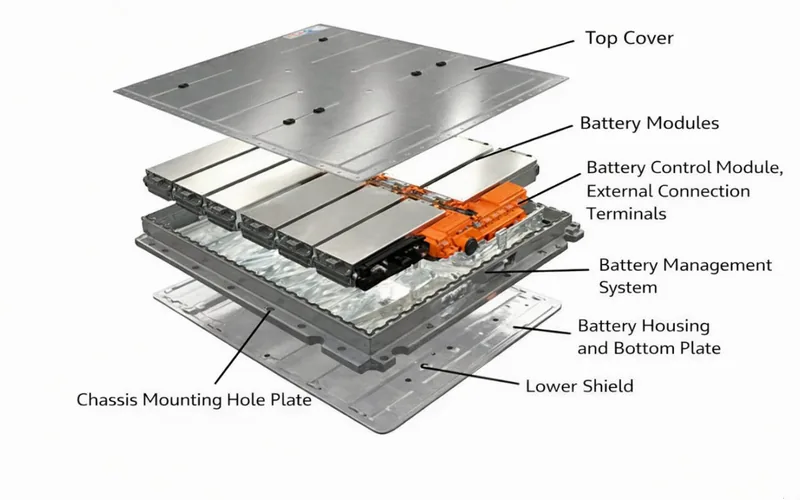
ToneCooling Texas helps US battery teams review EV battery cold plates for temperature uniformity, coolant routing, aluminum structure selection, sealing, and production feasibility.
Application fit: BEV modules, HEV packs, eVTOL batteries, BESS containers, charging systems, and battery thermal runaway management interfaces.
Prismatic, pouch, and cylindrical cell cold plates for battery-electric vehicle pack thermal management.
Compact, weight-optimized aluminum cold plates for hybrid vehicle and electric aircraft battery packs.
Grid-scale battery energy storage and DC fast-charging system thermal management.
ToneCooling's FSW-joined EV traction battery cold plate route is validated to the following typical performance envelope. Exact values depend on alloy grade, plate thickness, and channel geometry — final selection should be validated against thermal resistance, flow resistance, and coolant chemistry together.
| Material | AL-3003 aluminum |
|---|---|
| Max thermal resistance | ≤ 0.03°C/W |
| Helium leak test | 100% tested; acceptance criteria agreed per project |
| Min pressure rating | ≥ 1 MPa |
| Flatness | ≤ 0.1 mm/100mm |
Field result: EV battery packs using FSW-joined cold plates have reported approximately 25% longer cycle life in deployed applications, attributed to improved pack temperature uniformity versus fusion-welded alternatives.
Fast quotation depends on boundary conditions, not only a product name. US buyers should send enough data for thermal, hydraulic, mechanical, and production review.
| Process options | Stamped-brazed aluminum, FSW aluminum cold plates, roll-bond panels, serpentine or parallel channels, and leak-tested module-level assemblies. |
|---|---|
| USA support role | ToneCooling Texas handles RFQ intake, US-hours communication, NDA coordination, DFM follow-up, and optional US-side commercial routing. |
| Manufacturing disclosure | Manufacturing is performed by ToneCooling Technology Co., Ltd in Huizhou, China. The Texas site is the North American RFQ and engineering communication route. |
Electric aviation — eVTOL battery heat exchanger (engineering review). An electric-aviation developer asked ToneCooling to assess a 1.3-meter-class, thin-wall, multi-channel aluminum battery cold plate with a functional insulation coating. Our engineering team delivered a full DFM and process route — extrusion, brazing, coating and a leak, pressure-drop and Hi-Pot validation plan — before any prototype commitment. Read the eVTOL cold plate case study →
Send drawings, heat load, coolant, flow rate, pressure drop limit, envelope, target quantity, and timeline. An engineer reviews every RFQ and replies by email with next steps.
Yes. ToneCooling Texas coordinates US RFQs for EV battery cold plates and supports DFM review before prototype planning.
Provide cell layout, pack envelope, heat load, coolant, flow rate, temperature uniformity target, pressure drop limit, and annual volume.
Yes. ToneCooling supports aluminum cold plate routes including FSW, stamped-brazed, and roll-bond structures depending on volume and geometry.
On ToneCooling’s FSW-joined EV traction battery cold plate route (AL-3003 aluminum), typical maximum thermal resistance is ≤ 0.03°C/W, 100% helium leak testing (acceptance criteria agreed per project), minimum pressure rating ≥ 1 MPa, and flatness ≤ 0.1 mm/100mm. Field-deployed EV battery packs using this joining route have reported approximately 25% longer cycle life, attributed to more uniform pack temperature.
Prototype lead time is typically 4–6 weeks including design and simulation. Custom samples are available from a single piece, and production lead time is confirmed at quotation for each project.
Review CFD, FSW, TLP, vacuum brazing, and leak testing capabilities.
Use the Texas LLC path for US-hours communication and RFQ handling.