EV Powertrain & Battery
Weight-sensitive battery pack and power electronics cooling for EV and eVTOL platforms.
ToneCooling Texas helps US OEMs source custom aluminum liquid cold plates when weight, cost, or large-area structure matter more than maximum thermal conductivity — through US-hours engineering review and RFQ coordination with ToneCooling's Huizhou facility.
Aluminum cold plates trade some thermal conductivity for lower weight and cost versus copper, making them the right default for weight-sensitive EV, aerospace, and large-area cooling structures with moderate heat flux.
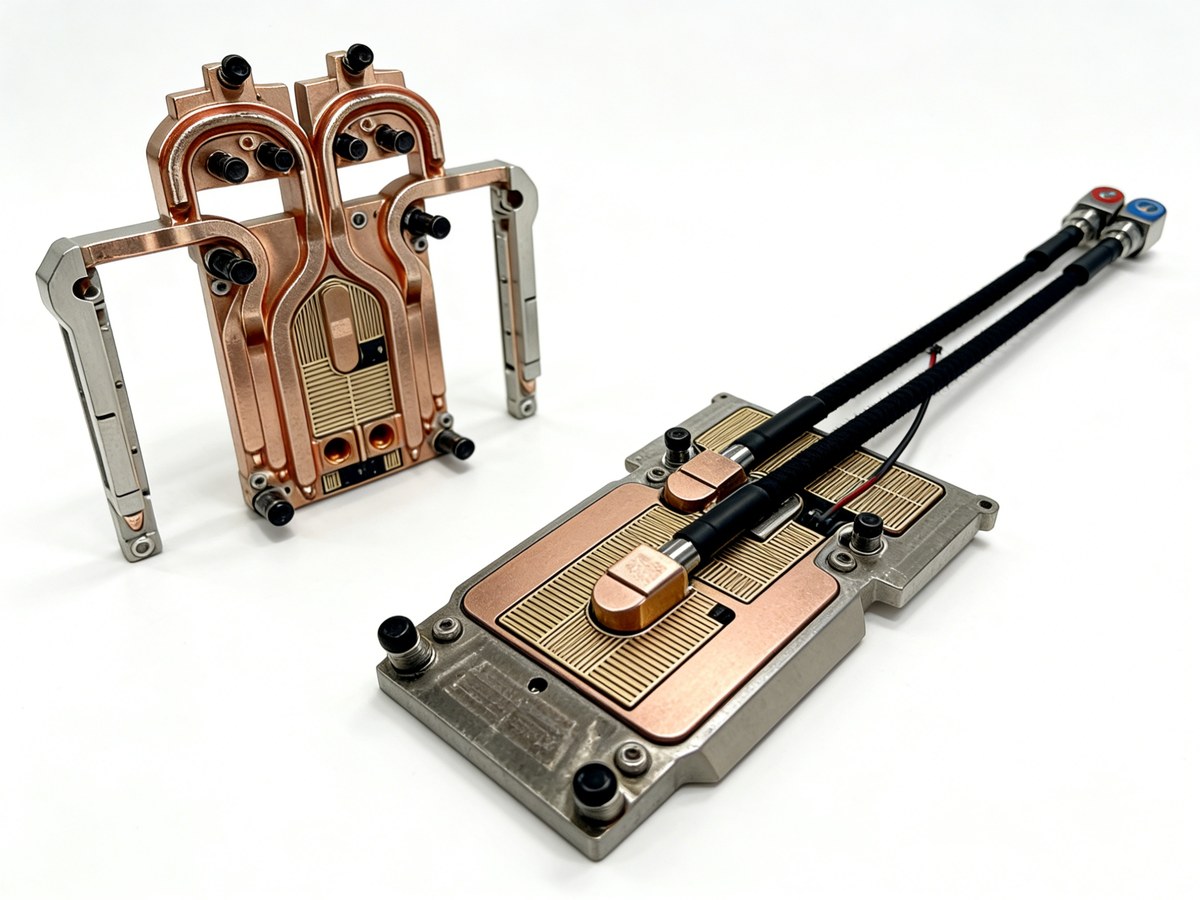
Aluminum alloys (commonly 6061 and 6063) conduct heat at roughly 200–235 W/(m·K), compared to approximately 390–401 W/(m·K) for copper — copper conducts heat roughly twice as fast. But aluminum's density is about a third of copper's (~2.7 g/cm³ vs. ~8.9 g/cm³), so an aluminum structure of equal size is significantly lighter. For weight-sensitive EV, aerospace, and large-area cold plates with moderate heat flux, aluminum's lower weight and cost often outweigh copper's conductivity advantage. For concentrated high heat-flux hot spots — direct-to-chip GPU or CPU cooling — copper is typically the better default.
| Friction stir welding (FSW) | Solid-state joining well suited to larger aluminum structures with sealed internal channels, reviewed for weld-tool access, flatness, and pressure boundary. |
|---|---|
| CNC-machined + bonded cover | Machined channel geometry with a bonded, brazed, or welded cover plate — fits complex or prototype-stage geometries. |
| Vacuum brazing | Sealed multi-layer aluminum structures for compact internal channel routing and high heat-flux packaging. |
Weight-sensitive battery pack and power electronics cooling for EV and eVTOL platforms.
Large-area structures where weight budget outweighs peak thermal conductivity.
Cost-sensitive cooling for inverters, converters, and large-format industrial electronics.
Fast quotation depends on boundary conditions, not only a product name. US buyers should send enough data for thermal, hydraulic, mechanical, and production review.
Send drawings, heat load, coolant, flow rate, pressure drop limit, weight constraint, and timeline. An engineer reviews every RFQ and replies by email with next steps.
Aluminum suits weight-sensitive or large-area structures with moderate heat flux, where its lower density and cost outweigh copper's higher thermal conductivity.
Aluminum alloys typically conduct heat at roughly half the rate of copper, but weigh about a third as much for the same volume, which matters for EV and aerospace applications.
Friction stir welding (FSW) suits large sealed aluminum channels, CNC machining with a bonded or brazed cover suits complex geometries, and vacuum brazing suits sealed multi-layer structures.
Yes. ToneCooling Texas coordinates US RFQs while manufacturing is performed by ToneCooling Technology Co., Ltd in Huizhou, China.
Reference thermal conductivity values for aluminum and copper alloys are documented in independent engineering material property tables, such as the metals thermal conductivity reference from The Engineering ToolBox.
Review copper vs. aluminum and other custom cold plate material options.
Review CFD, FSW, TLP, vacuum brazing, and leak testing capabilities.